Amber used cooking oil being poured from a steel container into a large stainless pan, a fryer basket on the counter behind

Service area · Scottsdale, AZ

Grease Trap Cleaning Scottsdale, AZ

You run a kitchen in Scottsdale. Tell us the device and the last pump-out date. We will call you back shortly.

Form open 24/7

Get a call back

Phoenix + 15 Valley cities

Scottsdale sets its own grease trap rules, and they are close to Phoenix's. A hydromechanical trap has to be pumped at least every 30 days, a gravity interceptor at least every 90, and every service has to be documented and kept at the restaurant for 3 years. What makes Scottsdale different is not the calendar, it is the building stock: a high share of the city's kitchens sit in resort properties, in Old Town buildings that predate the current code, and in strip centers where the interceptor lids are under a parking space.

The schedule is the easy part. The hard part is access and volume. A resort banquet kitchen can serve several times more covers on a Saturday than on a Tuesday, and the interceptor has to handle the peak. An Old Town restaurant in a 1950s building may have a trap that was sized for a different menu, and no amount of pumping will make it behave like a modern device.

01 / City rules

What Scottsdale requires

Scottsdale Revised Code 31-167 requires grease interceptors and traps to be cleaned and maintained so they function as designed, with the cleaning documented. The city's restaurant inspection form spells the intervals out: traps every 30 days, interceptors every 90 days, and records retained for 3 years at the facility.

The physical test used by several Valley programs is that the device has to be pumped before the grease and solids reach a quarter of its capacity. Scottsdale's inspectors also look at the lids, the baffles and the outlet, because a device that is pumped on schedule and missing a baffle is still sending grease to the sewer.

The program is run by Scottsdale Water Resources, at 9312 N. 94th St., and the Scottsdale pretreatment program page (opens in a new tab) is the place to start when a pumper finds a problem the restaurant cannot fix, or when a new owner inherits a device with no history.

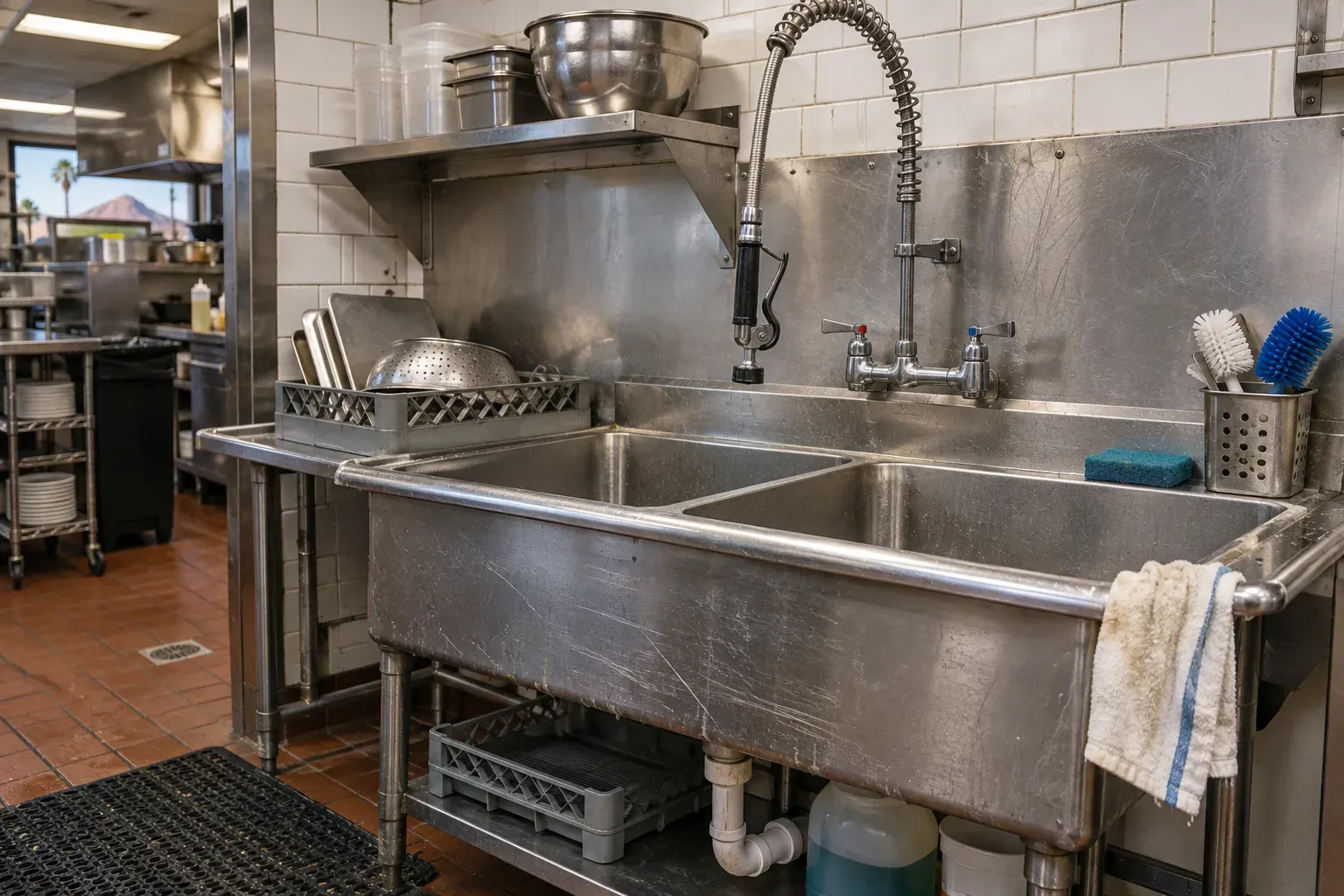
Stainless steel dishwashing station with a pre-rinse spray arm, a three-compartment sink and a dish rack under the table

02 / Service area

Why Old Town kitchens need a different look

Old Town is the densest restaurant district in the city, and much of it was built before grease interception was standard. A kitchen on Scottsdale Road or Craftsman Court may have a small indoor trap, a shared line with a neighbor, or an interceptor under a sidewalk that nobody has opened in a year.

Three things go wrong in buildings like that. The trap is undersized for the current menu, so it fills in 2 weeks. The line between the trap and the sewer has decades of grease in it, so a pump-out does not fix a slow drain. And the lids are inaccessible, so the service takes longer and costs more.

The fix is a measurement, not a schedule. Record the grease and solids depth at the first 2 visits. If the trap is at 20 percent or more at 30 days, the device is at its limit and the options are a shorter interval, a larger trap or a change in kitchen practice. If the depths are flat, the schedule is fine and the money is better spent on the line.
03 / Good to know

Resorts, event kitchens and seasonal peaks

Scottsdale's resort corridor runs from the Camelback corridor through Kierland and up to DC Ranch, and those kitchens have a load profile that a monthly calendar does not describe. A banquet operation can push a week's worth of grease through the system in one event weekend, and the interceptor that is fine in July can be at 25 percent in February.

For those kitchens the useful practice is a pre-event check. Measure the interceptor before a big booking, pump if it is above 15 percent, and keep the manifest with the event file. It is cheaper than a backup during a wedding, and it gives the property a record that shows the device was managed, not just pumped.

Seasonality cuts the other way in summer. A restaurant that loses a large share of its covers in July may not need the same interval it needs in March, but the city interval still applies.

Technician in a dark work shirt and a kitchen worker in an apron looking together at a tablet beside a three-compartment sink

04 / How it works

What a Scottsdale pump-out should include

  • The device measured before pumping, with the grease and solids depth written down.
  • A full pump-out of every compartment, not just the first.
  • Wall scraping and baffle cleaning.
  • Lid and gasket check, with a note on any defect.
  • A manifest with the gallons, the disposal site and the date.
  • A service log entry the restaurant can file.

The manifest matters more in Scottsdale than in some other cities because the records requirement is explicit and the inspectors ask for the file. A restaurant that can produce 3 years of manifests and a log with depths is a restaurant that has a short inspection.

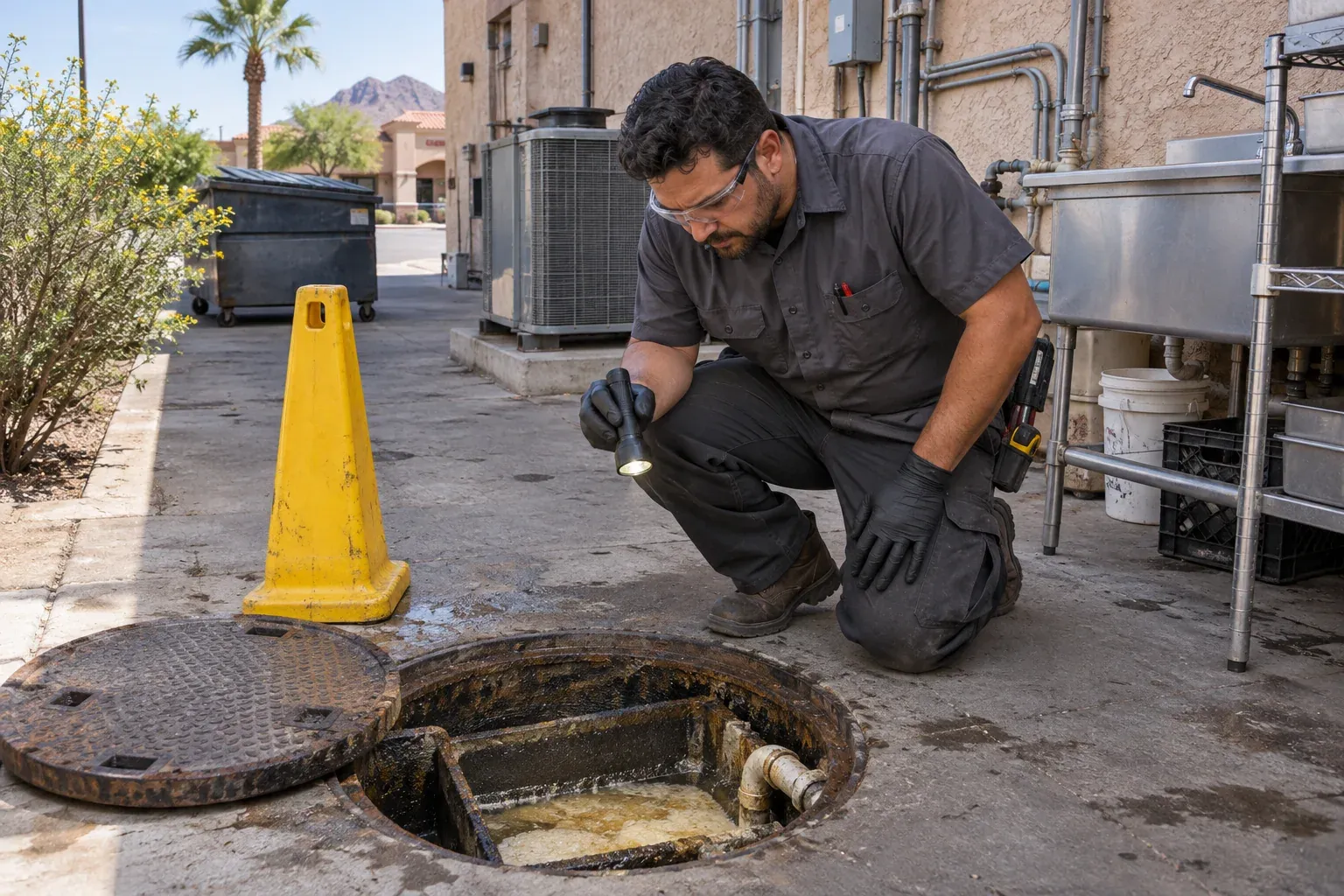
Technician crouching beside an open interceptor access with a yellow safety cone, the cover set on the concrete next to it

05 / Costs

What it costs

Scottsdale pricing tracks the national ranges on the cost page: $125 to $325 for a scheduled indoor trap, $225 to $400 for a 1,000 gallon interceptor, and $400 to $700 for a 2,000 gallon tank. Resort and event kitchens often sit at the top of the range because the devices are larger and the access is tighter.

The variables are the same everywhere. Gallons, access, how full the device is, the disposal fee and the time of day. A lid under a parking space in Old Town adds time. A tank in a resort service yard with a gate code adds time. A kitchen that has never had the line jetted adds a jetting visit.

06 / Septic

Is a Scottsdale business on septic, not sewer?

Scottsdale's own sewer paperwork shows that septic tanks still exist inside the city. Its sewer tap requirements say that a property converting from an onsite septic system to the public sewer pays Sewer Development Fees, and that the septic tank must be abandoned under County Health Department requirements where that applies, citing A.A.C. R18-9-A309(D) and Chapter 2, Section 8 of the Maricopa County Environmental Health Code.

That tells a Scottsdale business owner 2 things. First, a building with a tank can choose to connect, and the cost is a development fee based on meter size plus the abandonment. Second, until it connects, the tank is the business's own responsibility, and it needs the pump-out schedule in the septic tank pumping guide.

Scottsdale also operates the Town of Paradise Valley's sewer system through an agreement, which is a reminder that the city line and the property line are not always the same. The grease device is a separate matter on either system; start with the grease trap cleaning page for Scottsdale.

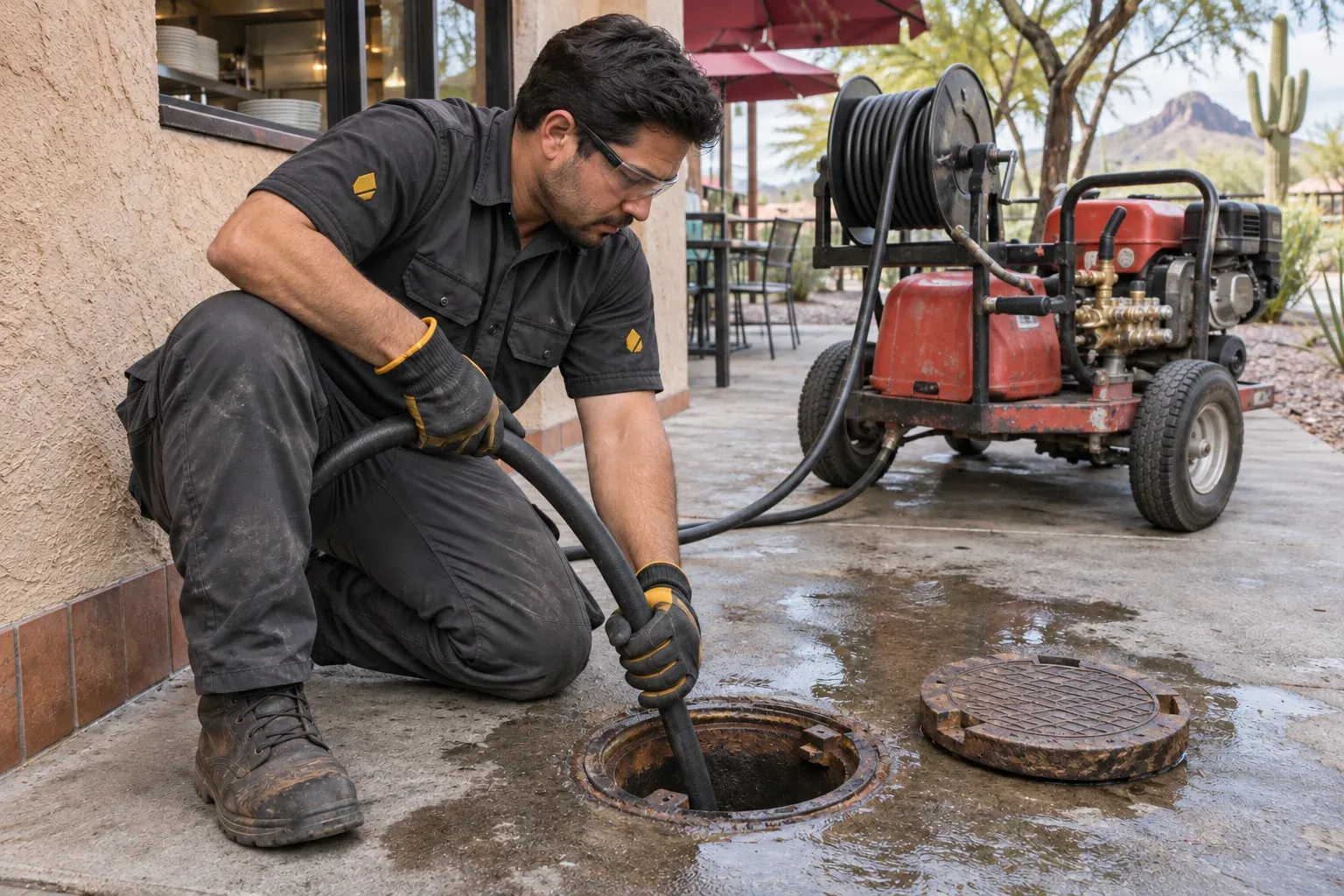
Technician kneeling at an open drain access holding a jetting hose, a red pressure washer unit on wheels behind him

Rule card · Scottsdale Revised Code 31-167

Scottsdale grease trap rules

01Indoor grease trap
Every 30 daysTrap pumped at least every 30 days.
02Outdoor interceptor
Every 90 daysGravity interceptor pumped at least every 90 days.
0325 percent rule
Several Valley programs, including Phoenix, Chandler and the Salt River Community, use the same physical rule: grease, oil, sand, sludge and solids may not exceed 25 percent of the device's liquid volume, measured at the static water level.
04Records to keep
3 years at the facility
05Additives
Cleaning and maintenance must be documented; an additive is not a substitute for cleaning.
07City FOG program
Scottsdale Water Resources

Service area map

Scottsdale and the areas around Phoenix

The map shows Scottsdale and the address in Phoenix. Use the buttons below it to open any area page.

All areas
Open in Google Maps (opens in a new tab)

07 / 4 questions

Questions from Scottsdale kitchens

Still have a question?

Send the form with a short note. Someone from our team will call you back soon.

Get a call back

Q.01

Is the Scottsdale interval different from Phoenix?

The numbers are the same, 30 days for a trap and 90 for an interceptor, but they come from a different code section and the inspection form is Scottsdale's. The city that matters is the one the address drains into.

Q.02

Does a resort kitchen need more frequent service than 90 days?

The 90 day rule is a floor. A banquet kitchen that hits 25 percent in 60 days needs service at 60 days, and the depth measurements are what prove it.

Q.04

Can a restaurant in a historic Old Town building replace a small trap?

Yes, with a plumbing permit and a plumbing contractor, and the building's age may add constraints on where the new device can go. The first step is a measurement to confirm the existing device is actually the problem.

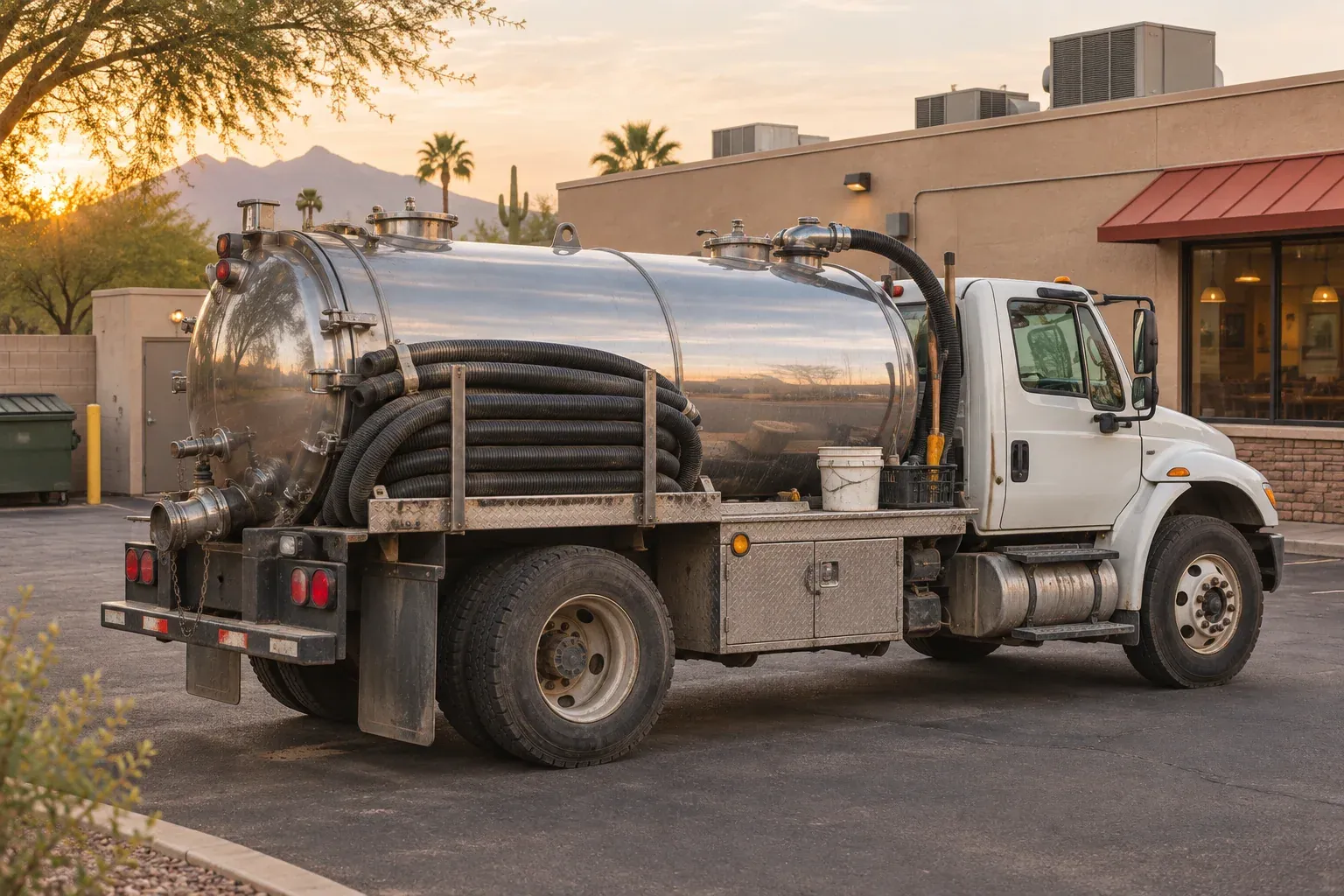
White vacuum service truck with a polished cylindrical stainless tank and coiled hoses parked behind a restaurant at sunset

Form open 24/7

Ask for a call back about your grease trap

Tell us which device and which kitchen. We will call you back shortly.

Thank you. You will be called back soon.

Grease backing up?Get a call back

Before you go: want a call back?

Give your name, phone number, ZIP code and the service you need. Someone will call you back about your grease trap.

Thank you. You will be called back soon.

Get a call back

Send it, and someone calls you back soon

Add details (optional)
How urgent is it?

The form is open day and night, and we will call you back shortly.

Get a call back

Send the form and someone calls you back soon.

Thank you. You will be called back soon.