Q.01
How often should a grease interceptor be pumped in Phoenix?
At least every 3 months for a food service establishment, and sooner if grease and solids reach 25 percent of the liquid volume. Phoenix City Code 28-15 C and B.
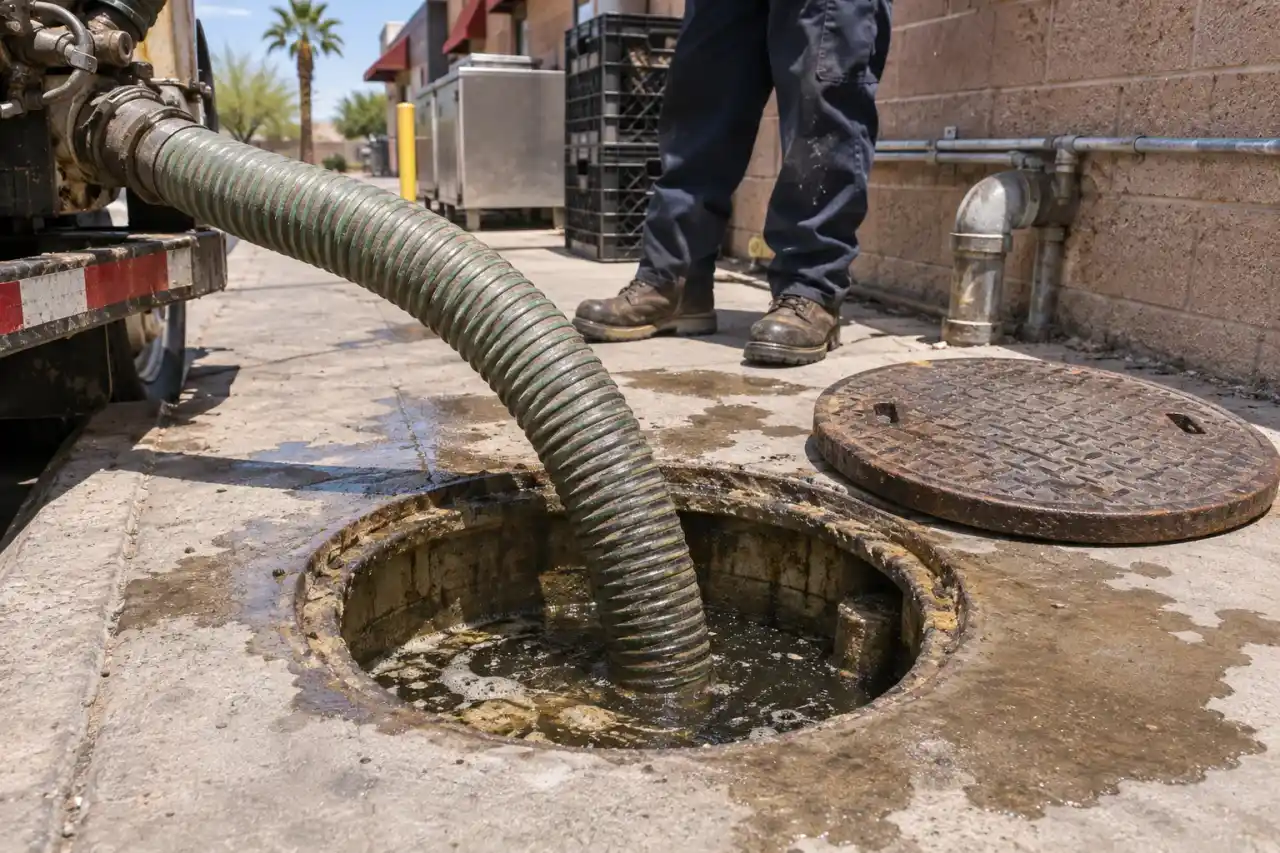
Service 02 of 09 · Phoenix, AZ
You need grease interceptor pumping in Phoenix, and city code 28-15 calls for a gravity interceptor pump-out at least every 3 months. Tell us the size and the last pump-out, and someone from our team will call you back.
Form open 24/7
Get a call back
Phoenix + 15 Valley cities
01 / What you get
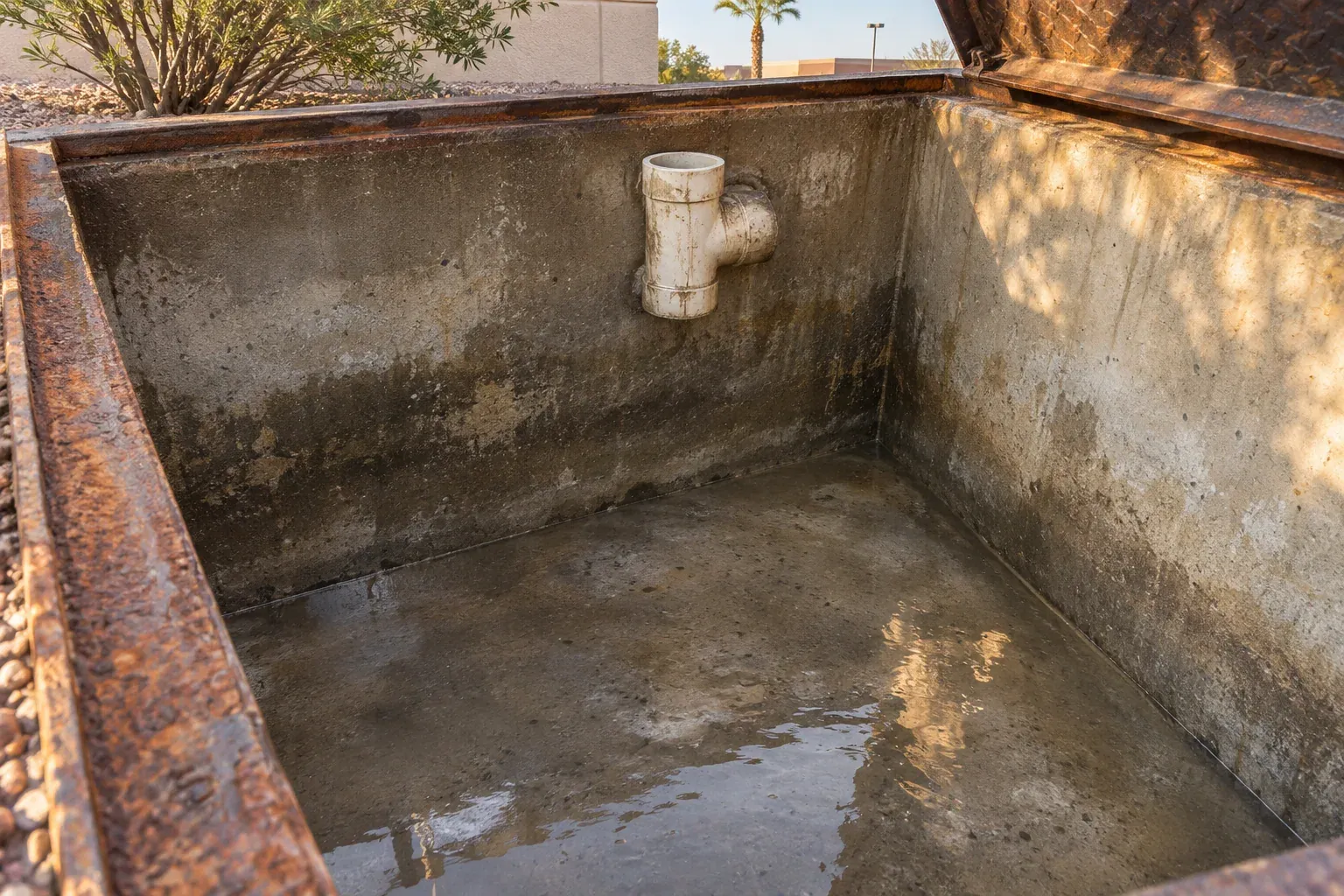
Grease interceptor pumping in Phoenix is the outdoor version of trap service, at a different scale. The device is a buried concrete or fiberglass tank, usually with two or three compartments, rated in hundreds or thousands of gallons. Phoenix City Code 28-15 C requires a food service establishment to pump and clean it at least once every 3 months, and 28-15 B requires the pump-out before grease and solids reach 25 percent of the liquid volume.
The pump-out is a full removal, not a skim. A vacuum truck pulls the liquid and the floating grease, then the walls and baffles are scraped, the compartments hosed and the inlet and outlet checked for blockages. The gallons removed, the disposal site and the condition of the device go on the manifest. That manifest is the record the city asks for, and it is the only reliable way to know whether a 90 day schedule is actually long enough for your kitchen.
02 / The signs
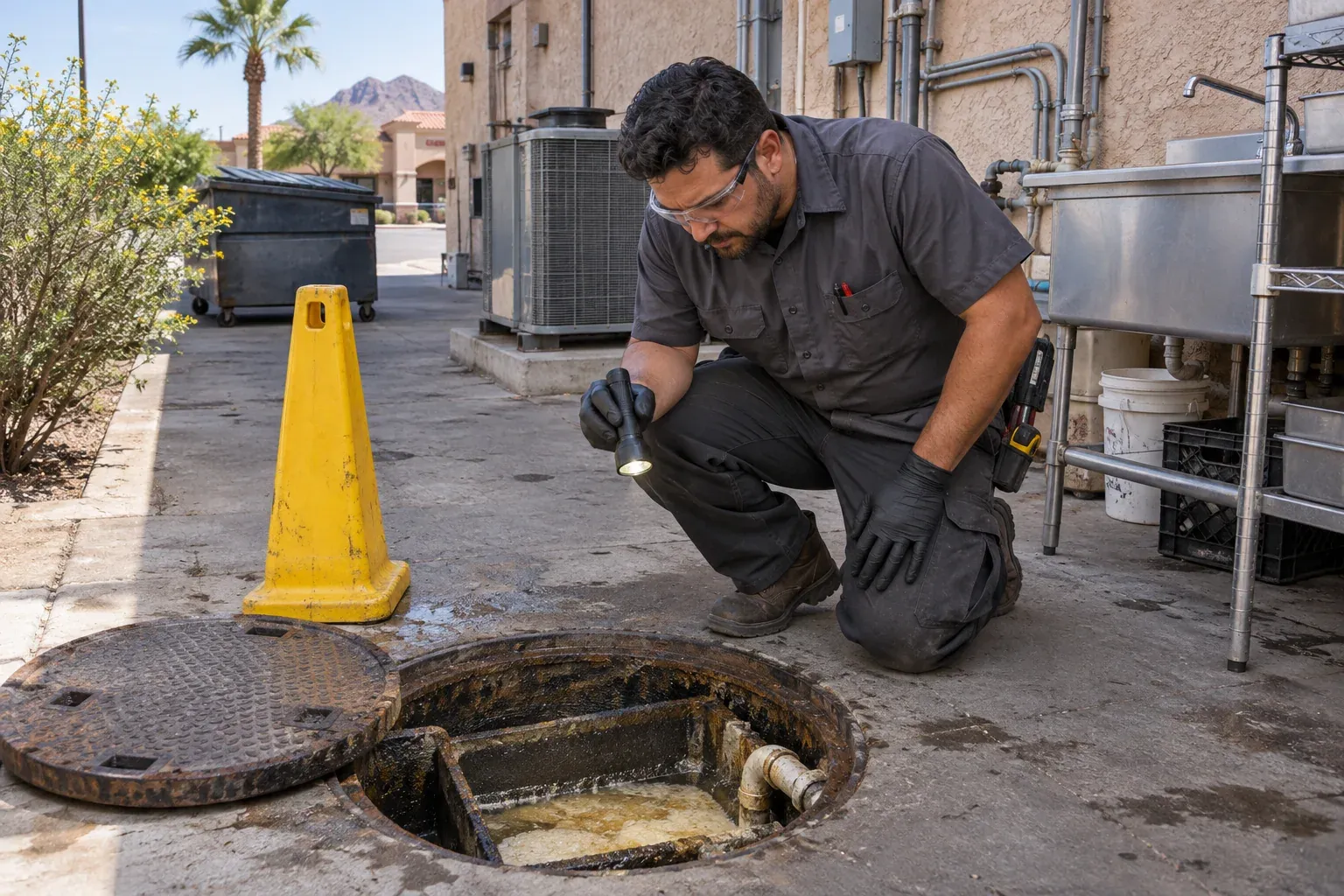
The first compartment has a grease layer more than a few inches thick.
The outlet compartment shows grease, which means carry-over is already happening.
The ground above the tank is soggy or smells, which suggests a cracked tank or a blocked outlet.
Floor drains in the kitchen drain slowly after a pump-out, which points to the line rather than the tank.
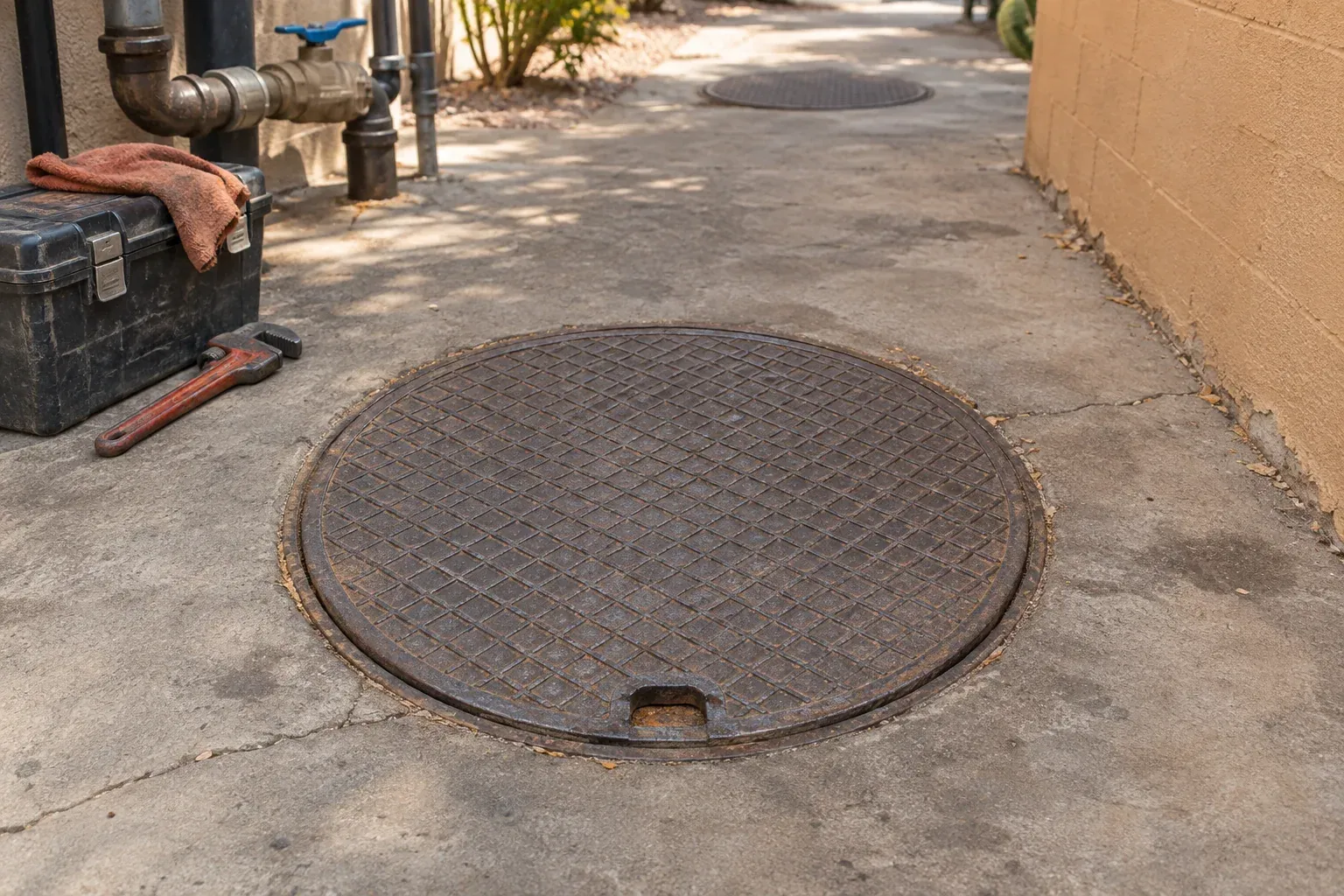
The lids are cracked, buried or missing, which makes service harder and lets runoff in.
Carry-over is the one to watch. Grease in the outlet compartment means the device is not doing its job, and the next stop for that grease is the city sewer. Gilbert and Chandler treat carry-over or grease leaving the device as the trigger for more frequent service, and Phoenix's 25 percent rule is the formal version of that idea.
03 / How it works
Your request starts a fixed sequence.
04 / Costs
In national cost ranges, scheduled interceptor service runs $225 to $400 for a 500 to 1,000 gallon tank, $225 to $315 for a 1,000 to 1,500 gallon tank on a service plan, and $400 to $700 for a 2,000 gallon tank, or $630 and up when it is overdue. A tank above 2,500 gallons or a multi-tank site can run $800 to $2,000 per visit. Public contract bids elsewhere for grease waste hauling have ranged from $0.14 to $1.95 per gallon, with most between $0.20 and $0.85.
The annual math is simple. A 1,000 gallon tank on a 90 day schedule is 4 visits, so $900 to $1,600 a year at scheduled rates. A 2,000 gallon tank is the same 4 visits at a higher per-visit price, so $1,600 to $2,800 a year. If the tank needs service every 60 days because the kitchen is high volume, the annual cost rises by half.
What changes the price: gallons, access, how full the tank is, the disposal fee, after-hours scheduling and the condition of the lids and baffles. A tank that has not been opened in 2 years may have hardened solids that take extra time to break up. The cost page breaks the ranges down by size.
05 / How it works
Wastewater enters the first compartment and slows down. Grease rises to the top and forms a mat. Food solids settle to the bottom. The middle layer, which is mostly water, passes under a baffle into the next compartment, where the separation repeats, and then out to the sewer.
The residence time is what makes it work. A 1,000 gallon tank that receives 2,000 gallons of wastewater a day has about 12 hours of holding time in theory, which is why a large tank can run 90 days where a small trap cannot run 30. Tempe's program sets the minimum interceptor at 500 gallons and the maximum at 2,500 gallons. Scottsdale's interceptor guidelines use the same 2,500 gallon figure for a practical reason: a standard vacuum truck carries about 2,500 gallons, so a larger tank means multiple loads or a larger truck, and the price goes up.
Three compartments are better than two for the same reason three settling stages beat one. The first compartment takes the heavy load, the second polishes, and the third is the last chance before the outlet. A two-compartment tank is legal in Phoenix for a gravity interceptor, and the city's FOG manual describes the smallest allowed unit as a 2-compartment, 2-manway, 500 gallon device.
06 / Good to know
Phoenix City Code 28-15 C: users of gravity interceptors at food service establishments must fully pump out and clean the interceptor at a frequency of not less than once every 3 months unless the Director grants a variance. Subsection B sets the 25 percent limit as measured at the static water level.
The difference between a 30 day trap rule and a 90 day interceptor rule is not a judgment about cleanliness. It is a function of volume and residence time. The trap holds tens of gallons and the interceptor holds hundreds or thousands, so the same kitchen load fills them at very different rates. What does not change is the physical test: if the mat plus the solids reach 25 percent at day 70, the tank is due at day 70.
Records are the other half of the rule. Subsection F requires FOG compliance records: cleaning, volume removed, device capacity, disposal, repair, replacement and maintenance to stay at the facility for 3 years. The record has to be available to the Director on request, which in practice means a binder in the office and a photo of each manifest on a phone.
07 / How it works
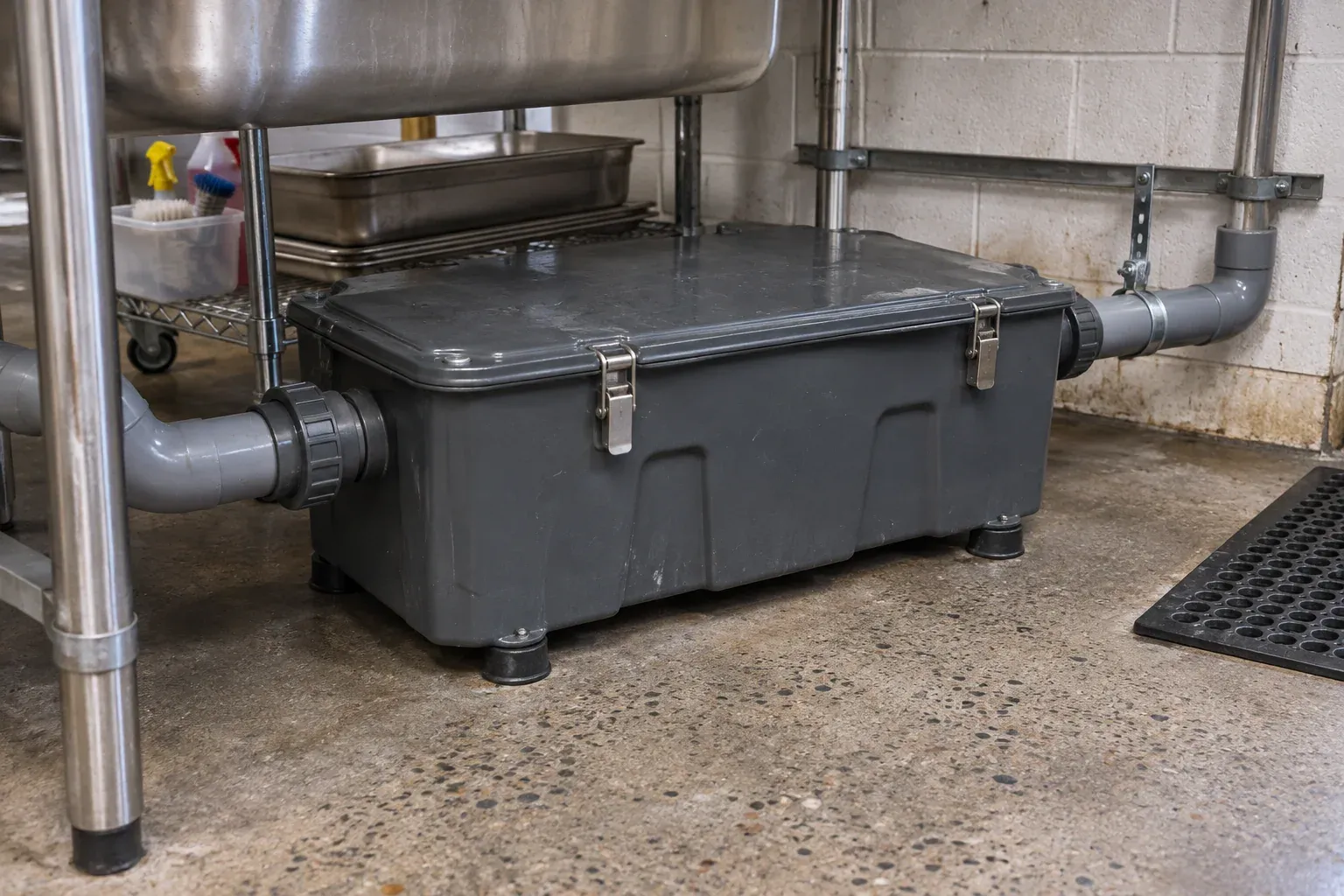
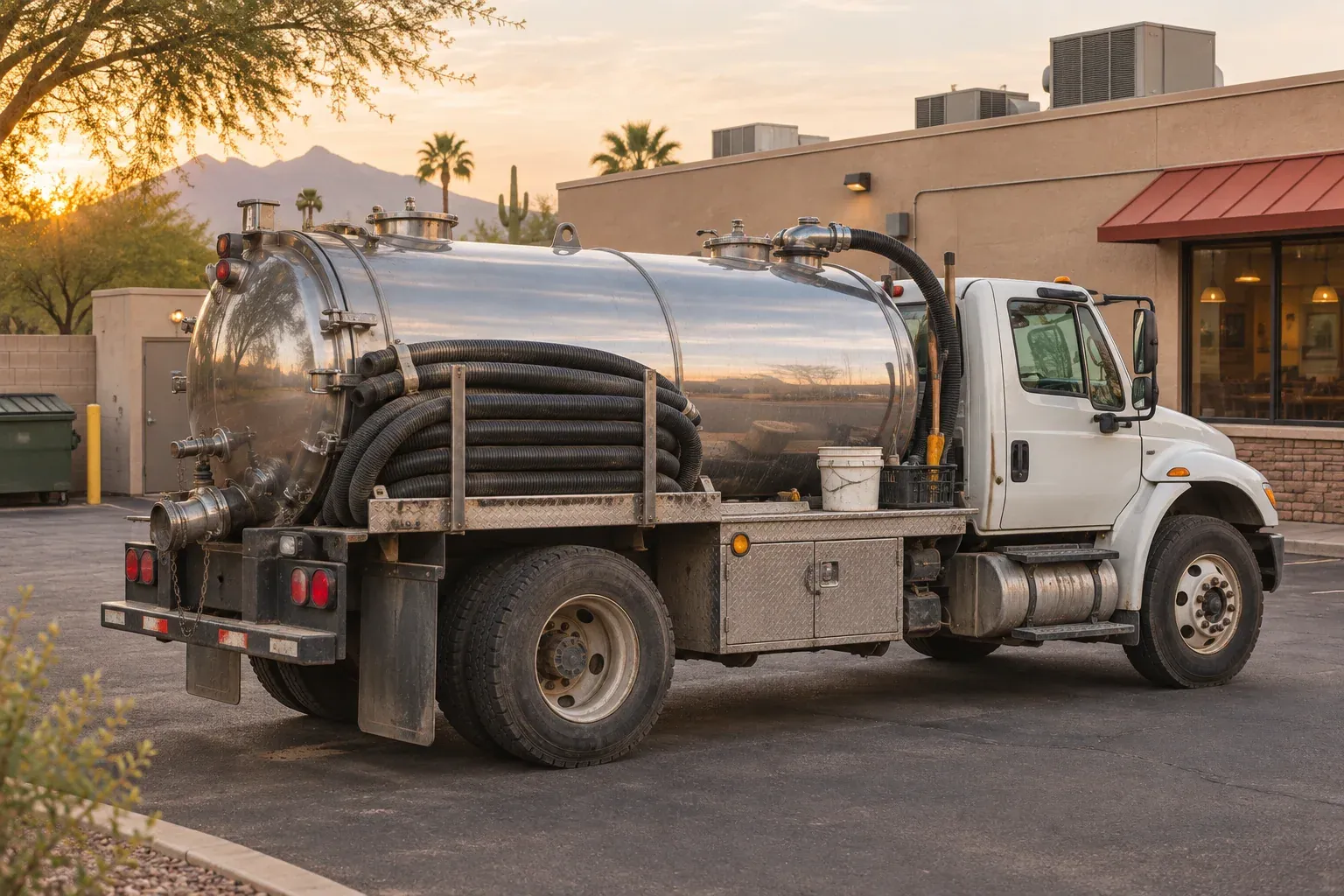
The truck parks as close to the lids as access allows. If the lids are in a drive lane or under a car, that has to be sorted before the visit, because a hose run of 100 feet is a different job than a hose run of 30.
The lids are opened and the device is measured. A sludge judge or a weighted tape gives the depth of the grease mat and the depth of the solids. Those numbers determine how full the tank is and they belong on the manifest.
The vacuum pulls the liquid and the grease from each compartment in sequence. The walls get scraped, the baffles get cleaned, and the compartments get hosed. The inlet and outlet are checked for blockage, and any cracked lid, missing gasket or damaged baffle is noted for the restaurant.
Then the lids go back on and the paperwork is written. A good manifest lists the volume removed, the disposal site, the date and the device condition. A manifest that only says "pumped" is not enough to prove compliance and it is not enough to plan the next interval.
08 / Services
If the invoice says "grease trap" but the device is a 1,000 gallon tank under the lot, the wrong service is being sold. Commercial grease trap cleaning is a shorter job with a portable unit. The interceptor service is a truck, a long hose and a manifest.
The rule of thumb from Tempe's program is useful: 4 or fewer kitchen fixtures on the grease line can use a trap, and more than 4 fixtures, or a commercial dishwasher, needs an interceptor. Phoenix's FOG manual also calls for an interceptor wherever there is a commercial dishwasher or a food waste disposer. If you are not sure, the schedule check asks for the device type and the size, and returns the clock that applies.
Related work sits on either side of a pump-out. If the kitchen line is blocked, hydro jetting clears the pipe. If the tank has a broken baffle or a cracked lid, grease trap repair is the next call. And if the device is being installed for the first time, that is a plumbing permit job, not a pumping job.
09 / 6 questions
Still have a question?
Send the form with a short note. Someone from our team will call you back soon.
Get a call backQ.01
At least every 3 months for a food service establishment, and sooner if grease and solids reach 25 percent of the liquid volume. Phoenix City Code 28-15 C and B.
Q.02
500 to 2,500 gallons. Tempe sets 500 gallons as the minimum and 2,500 as the maximum, and Phoenix's smallest approved gravity interceptor is 500 gallons. Larger sizes come from a fixture count calculation.
Q.03
The combined grease, oil, sand, sludge and solids in the device must not exceed 25 percent of its total liquid volume, measured at the static water level. Phoenix City Code 28-15 B. It is a physical limit that applies alongside the calendar.
Q.04
A standard vacuum truck holds about 2,500 gallons, so a tank at that size is one full load and a tank above it needs multiple loads or a larger truck. Scottsdale's interceptor guidelines name that truck capacity as the reason costs step up above 2,500 gallons.
Q.05
No. Interceptor grease is wastewater waste. Phoenix requires it to be lawfully disposed of, and it may not be put back into the interceptor, a sewer cleanout or another opening. Used cooking oil from the fryer is a separate stream that rendering companies collect.
Q.06
The time depends on the tank size, the hose run to the lids and how hard the solids have set.
Form open 24/7
Ask for a call back about your grease trap
Tell us which device and which kitchen. We will call you back shortly.
Thank you. You will be called back soon.