Q.01
Is the Glendale interval really 180 days?
City Code 33-238 sets 180 days as the minimum for a full pump-out and cleaning. The 25 percent capacity limit can require service sooner.
Service area · Glendale, AZ
You run a kitchen in Glendale. Tell us the device and the last pump-out date. We will call you back shortly.
Form open 24/7
Get a call back
Phoenix + 15 Valley cities
Glendale's grease trap rule gives a restaurant 6 months between pump-outs, with 2 conditions that are easy to miss. The cleaning has to be complete, which means the walls and the compartments, not just the liquid. And the waste that comes out cannot be put back, which rules out the old practice of decanting the water and returning it to the tank.
Those 2 conditions are why a Glendale grease trap cleaning is priced on labor and not just gallons. A partial pump that leaves the solids and the wall film is not a cleaning under the code, and the record of a partial pump is a record of a partial pump. For a buried tank the same full scrape applies to grease interceptor pumping, compartment by compartment.
01 / City rules
City Code 33-238 requires the interceptor to be pumped and cleaned completely at least every 180 days. It prohibits decanting the removed waste back into the device or into the sewer. It requires records at the facility for 3 years. The 25 percent capacity standard applies as the operating limit, because a device that is a quarter full is not separating properly even if the calendar says it is due next month.
The 180 day number is a floor for a well sized device. A Glendale restaurant with a 1,000 gallon interceptor and a fryer-heavy menu can hit 25 percent in 90 days, and the code's floor does not protect it. Measurement is the only way to know which case applies.
02 / Schedule
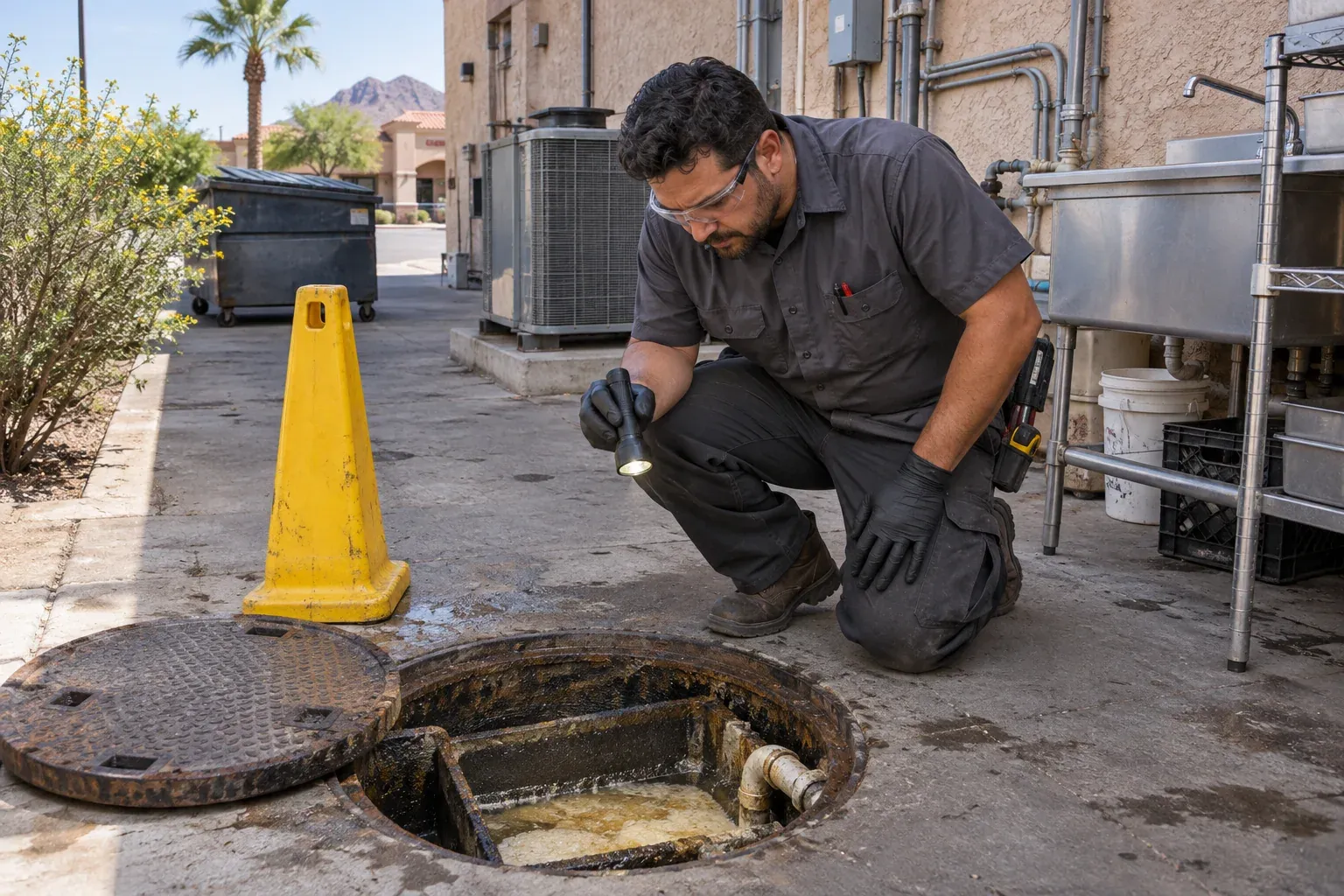
Glendale's restaurant density is split between the Westgate Entertainment District, the stadium and arena complex, and the older commercial corridors along Glendale Avenue, 59th Avenue and Bell Road. The Westgate kitchens have an event-driven load: a concert or a football game can produce a surge of covers in a few hours.
Event-driven kitchens need a pre-event check, not a longer interval. Measure the device before a big weekend, pump if it is above 15 percent, and keep the manifest with the event record. A backup during a stadium event is the most expensive kind, because the kitchen cannot stop and the customers are already inside.
The older corridors have the opposite profile: steady neighborhood volume, older buildings, and traps that were sized for a different menu. A restaurant on Glendale Avenue in a 1970s building may have a 50 gallon trap serving a menu that now includes a fryer and a dishwasher, and the trap is the bottleneck.
03 / Service area
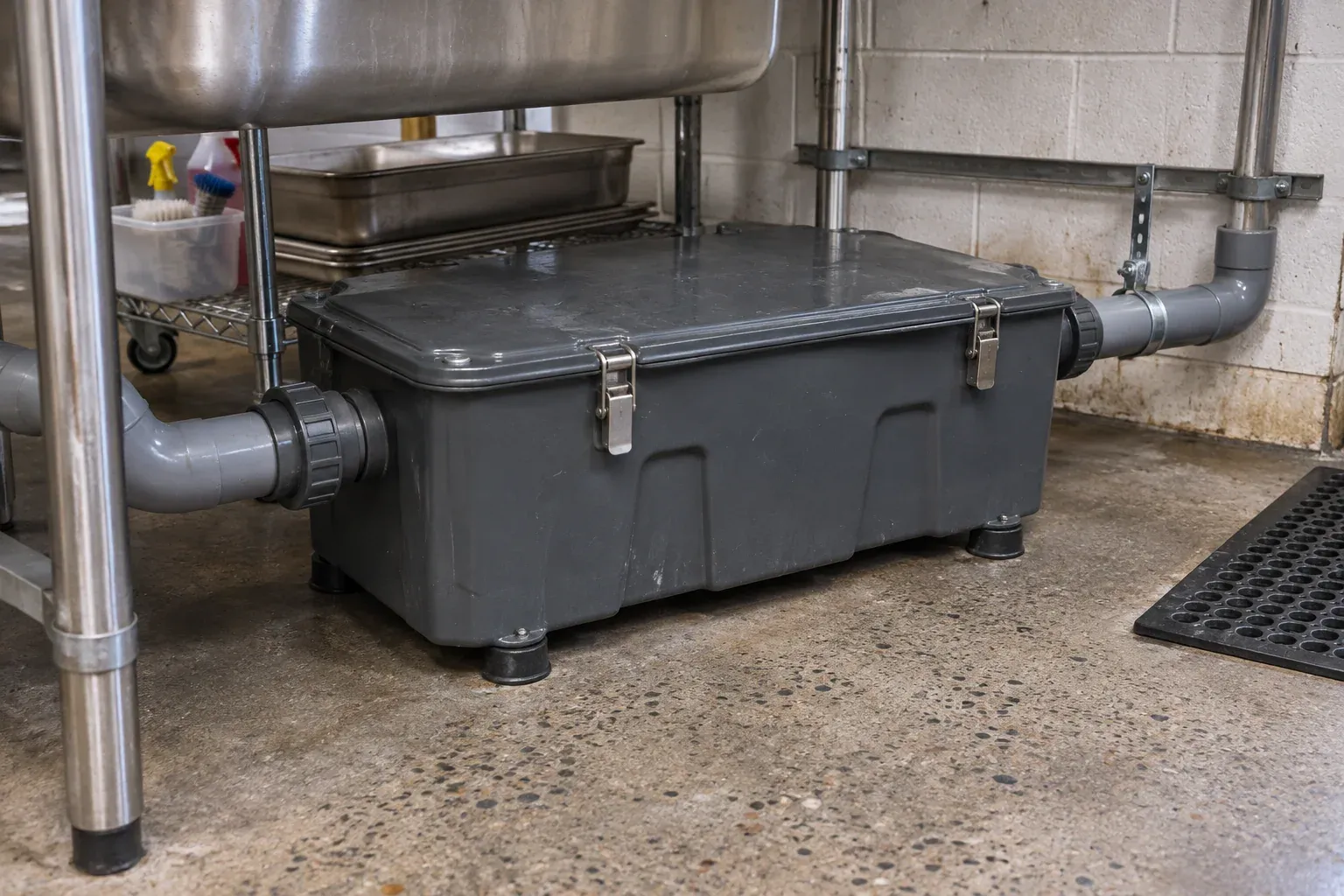
Downtown Glendale around 58th Avenue and Glendale Avenue has small storefront restaurants, many in buildings that predate the current plumbing code. The typical device is a small indoor trap, sometimes in a cabinet, sometimes in a closet, and the lid is often behind equipment.
Three practical notes for those kitchens. The trap has to be accessible for service, so a cabinet that has to be emptied every visit adds time and cost. The trap has to be measured, because a small device can be at 25 percent in 3 weeks. And the line between the trap and the sewer needs a jetting visit if the building is old and the drain has been slow for years.
04 / Records
Glendale requires 3 years of records at the facility. The record should show the date, the hauler, the gallons, the device and the disposal site, plus any repair. The decanting rule is worth writing into the file: a manifest that shows a small volume removed from a large tank is a red flag for a partial pump, and an inspector who sees it will ask questions.
The practical standard is that the volume removed should be close to the tank capacity on a full pump-out, minus what the truck cannot reach. If a 1,000 gallon tank shows 300 gallons removed, the job was a liquid pump, not a cleaning.

05 / Costs
Pricing follows the national ranges on the cost page. A 180 day schedule is 2 visits a year, $450 to $800 for a 1,000 gallon interceptor. A trap on a 30 day habit is 12 visits, $1,500 to $2,400 a year. Event-driven kitchens at Westgate often need 4 to 6 visits, which puts them at $900 to $2,400.
The variables are the same as everywhere: gallons, access, how full the device is, the disposal fee and the time of day. A lid in a stadium service yard with a security gate adds time. A trap in a cabinet adds time.
06 / Septic
Glendale's Water Services Department handles the treatment and collection of wastewater, and the city says all non-residential users must submit a questionnaire before discharging to the sewer system. That questionnaire is the clearest line in Glendale between a business on the city system and a building that is not. A restaurant that never filed one should find out why.
A Glendale building that runs on its own tank sits outside the city's pretreatment paperwork and inside Maricopa County's onsite wastewater code. The county requires written approval before a facility operates, bans cesspools outright and expects the system to treat wastewater that is predominantly of human origin, which is why a kitchen needs a grease interceptor ahead of it.
The septic tank pumping guide covers the intervals and the sale inspection. For the event-night volume around Westgate and the grease side of the job, start with grease trap cleaning in Glendale.
Rule card · Glendale City Code 33-238
Service area map
Glendale and the areas around Phoenix
The map shows Glendale and the address in Phoenix. Use the buttons below it to open any area page.
All areas07 / 4 questions
Still have a question?
Send the form with a short note. Someone from our team will call you back soon.
Get a call backQ.01
City Code 33-238 sets 180 days as the minimum for a full pump-out and cleaning. The 25 percent capacity limit can require service sooner.
Q.02
Decanting is removing the liquid from the tank, separating the grease and returning the water to the device. Glendale prohibits putting the removed waste back into the interceptor or the sewer.
Q.03
A full pump-out should be close to the tank capacity. A manifest showing a few hundred gallons on a 1,000 gallon tank suggests a partial pump.
Q.04
Event-driven kitchens usually do. A pre-event measurement is the cheapest way to decide, and the manifest is the record that shows the device was managed.
Form open 24/7
Ask for a call back about your grease trap
Tell us which device and which kitchen. We will call you back shortly.
Thank you. You will be called back soon.