Q.01
How often does Chandler require a pump-out?
There is no fixed interval in the code. Chandler's page gives 25 percent of capacity as the rule of thumb and says cleaning has to be more frequent if grease is seen leaving the device.
Service area · Chandler, AZ
You run a kitchen in Chandler. Tell us the device and the last pump-out date. We will call you back shortly.
Form open 24/7
Get a call back
Phoenix + 15 Valley cities
Chandler's grease trap rule is the cleanest in the Valley to explain: pump before the device is a quarter full, keep the service records for 3 years, and do not use chemistry to avoid the pump-out. Chandler's food service page gives 25 percent of total capacity as the rule of thumb and says records are retained onsite for 3 years, and City Code 51-24 prohibits additives used to reduce the need for pumping. There is no 30 day or 90 day number in the code to fall back on.
That makes Chandler a measurement city. A restaurant can pass with a 60 day interval or fail with a 30 day interval, depending on what the device looks like when it is opened. The record of the depth is the compliance document, and the schedule is a plan that the depth either confirms or corrects. A trap that reads 25 percent at 3 weeks needs grease trap cleaning then, and a buried tank that does the same needs grease interceptor pumping.
01 / The 25 percent rule
The measurement is taken at the static water level, with the device at rest. The grease mat floats, the solids settle, and the depth of each is read with a sludge judge or a weighted tape. The two volumes, added together, have to stay under a quarter of the tank.
For a 1,000 gallon interceptor that is 250 gallons, which is about 11 inches of combined depth in a tank with a 6 foot by 6 foot footprint. For a 50 gallon trap it is 12.5 gallons. The smaller the device, the faster the limit arrives, and that is why small traps need a monthly habit even in a city with no calendar.
Chandler's food service page notes that even the smallest device holds at least 25 gallons of liquid waste that cannot go in the trash, and that the owner can clean the device personally or use a Maricopa County licensed hauler.
02 / Records
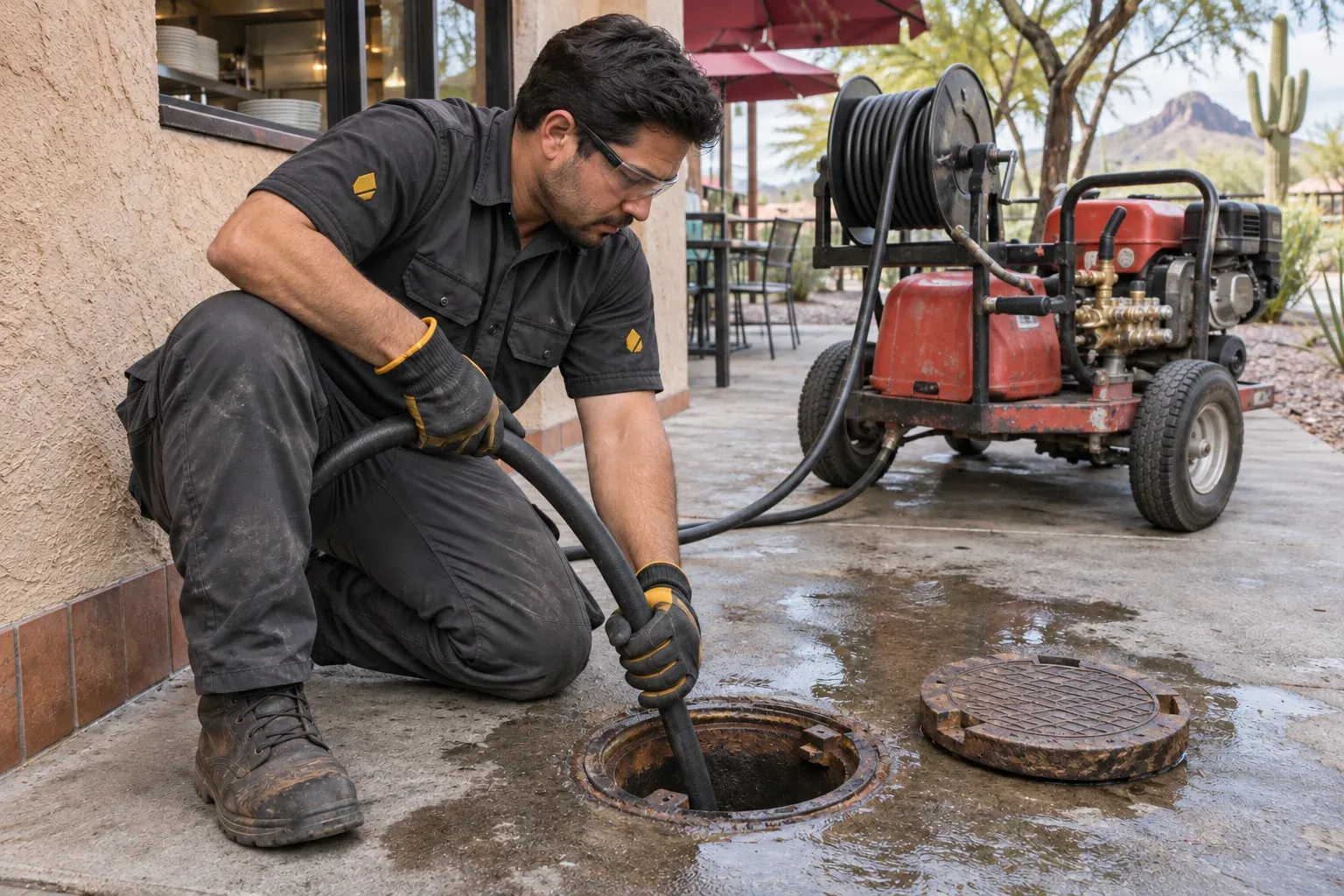
Chandler's food service page says records are retained onsite for 3 years and must include at least 5 things: the date of service, who did the service, the nature of the service, the total quantity removed, and the final disposal location. Keep the device capacity, any repair record and the service log with them, because the log is what makes the file readable.
Two details matter. The records have to be at the food service establishment, not at a corporate office. And the file has to cover the full 3 years, which means a restaurant that changes management or ownership needs the file to survive the change.
03 / Additives
Chandler City Code 51-24 prohibits introducing chemicals and other additives into a grease device to reduce or eliminate cleaning or pumping. The reason is hydraulic: an emulsified grease load passes through the device and coats the sewer, which moves the problem from the restaurant to the collection system.
A restaurant that has been using an enzyme product as a maintenance aid should read the code before renewing the contract. A product used alongside a physical pump-out is a different question from a product sold as a replacement for it, and the second one is the one the code addresses.
04 / Who does the work
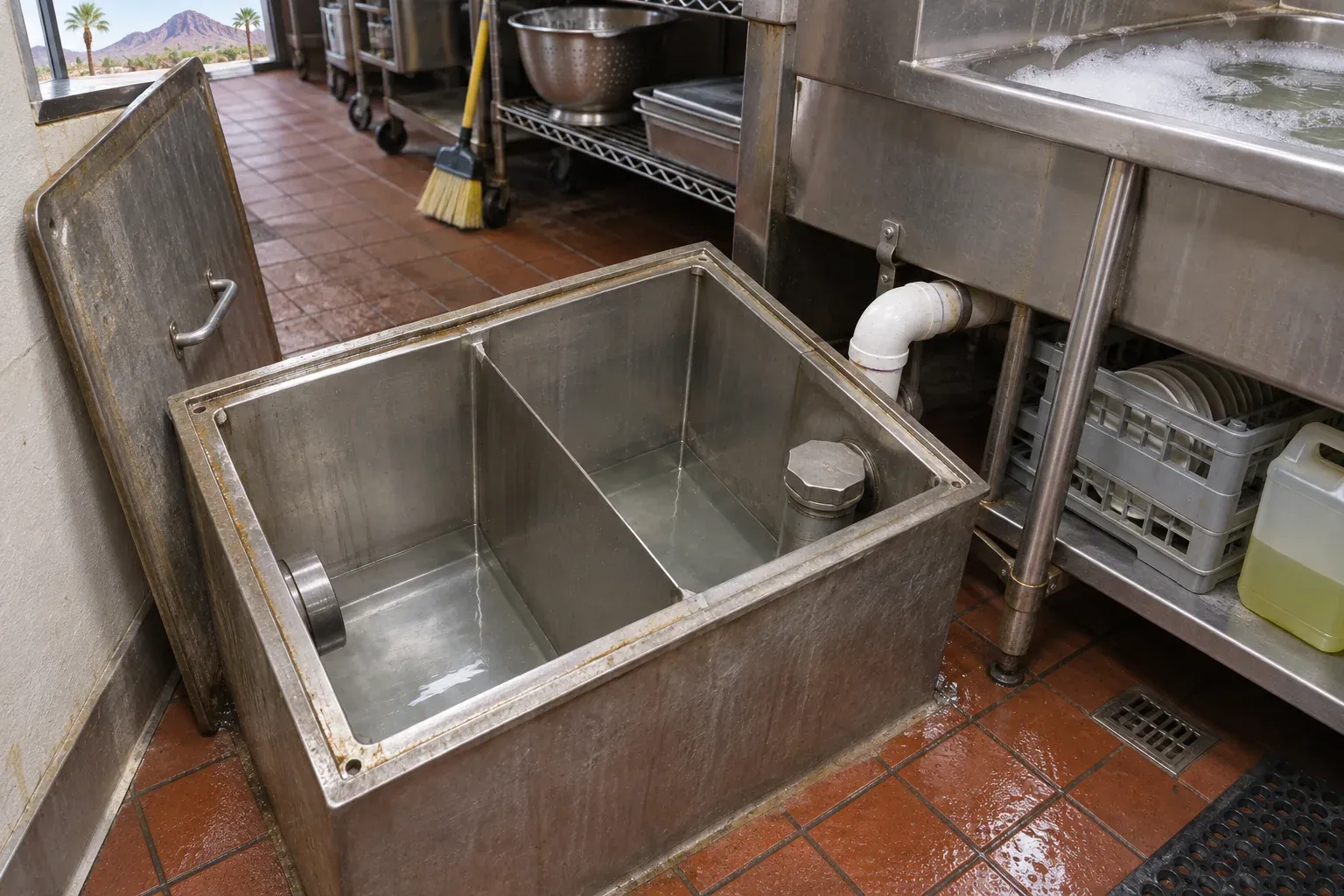
Chandler's page says a servicer has to be a Maricopa County Environmental Services licensed non-hazardous liquid waste hauler, or the employee's name and title must be recorded when the restaurant services the device itself. The final disposal location belongs in the record.
The county's permit page says vehicles used to collect and transport non-hazardous liquid waste must obtain a permit to operate.
05 / Good to know
Chandler's restaurant geography runs along Arizona Avenue, Chandler Boulevard, Price Road and the 202, with the historic downtown at one end and the newer developments at the other. Downtown Chandler has small, older buildings with traps that were sized for a different era. The Price Road corridor and the newer centers have engineered interceptors with accessible lids.
The Intel campus and the surrounding office development create a lunch market with high weekday volume and low weekend volume, which produces a fill pattern that a monthly calendar reads badly. A lunch-heavy kitchen can be fine at 45 days and over the limit at 60, and the only way to know is to measure.
06 / Costs
Pricing follows the national ranges on the cost page. A trap on a 30 day habit is 12 visits, $1,500 to $2,400 a year for a small device. A 1,000 gallon interceptor at 4 visits is $900 to $1,600. A kitchen that measures at 25 percent in 60 days is looking at 6 visits, $1,350 to $2,400.
The Chandler variable is the access in downtown and in the older centers along Arizona Avenue, where a lid can be behind a patio or under a shared dumpster pad. Settling the access plan before the first visit avoids a second trip.
07 / Septic
Chandler restaurants that are on the city sewer follow the city's food service rules, which are specific about records. Keep documentation of pumping, cleaning, maintenance and repairs on site for 3 years, with the service date, who serviced the device, what was done, the quantity removed and the final disposal location. The city names a Maricopa County Environmental Services non-hazardous liquid waste hauler as the servicer to list.
A Chandler building that is not on the sewer is under the county's onsite wastewater code instead, and the same record habit carries over to a septic tank. Put the pump-out receipt, the sludge and scum readings and the county paperwork in one file next to the grease log, so an inspector or a buyer finds everything in one place.
The practical test for any Chandler address is the utility bill: a sewer charge means the building is on the city line. No charge means asking the city utility and the county. The septic tank pumping guide explains the schedule and the permits, and fog compliance records shows what a clean file looks like.
Rule card · Chandler City Code 51-24
Service area map
Chandler and the areas around Phoenix
The map shows Chandler and the address in Phoenix. Use the buttons below it to open any area page.
All areas08 / 4 questions
Still have a question?
Send the form with a short note. Someone from our team will call you back soon.
Get a call backQ.01
There is no fixed interval in the code. Chandler's page gives 25 percent of capacity as the rule of thumb and says cleaning has to be more frequent if grease is seen leaving the device.
Q.02
Records of the pump-outs and maintenance, kept at the establishment for 3 years, covering the device, the volume, the hauler and the disposal.
Q.03
Not as a substitute for pumping. Chandler City Code 51-24 prohibits additives used to reduce or eliminate cleaning or pumping.
Q.04
Yes. Chandler notes that haulers must be licensed by Maricopa County, which is the non-hazardous liquid waste vehicle permit.
Form open 24/7
Ask for a call back about your grease trap
Tell us which device and which kitchen. We will call you back shortly.
Thank you. You will be called back soon.